
With cotton still figuring in the list of commodities that are produced using practices such as child labour, the Confederation of Indian Textile Industry (CITI) has entered into an understanding with the International Labour Organisation (ILO) to create awareness, share technical know-how and knowledge about better labour standards. These standards, which are part of ILO Fundamental Principles and Rights to Work (FPRW), will be tried on a pilot basis in major cotton-growing districts of Madhya Pradesh for one year starting in 2024.

According to an industry expert, companies such as Trident, Welspun India, Arvind, KPR Mill, Vardhman Textiles, Page Industries, Raymond, and Alok Industries stand to gain, as revenue from the US market accounts for 20-60 per cent of their earnings.

A new report indicates that India's textile recycling market is projected to reach USD 3.5 billion by 2030, potentially creating one lakh green jobs. The report highlights the current state of textile waste management and opportunities for circularity in the Indian textile industry.

The proposed trade deal with the 27-nation European Union (EU) is expected to provide zero-duty access to the $95 billion European market for Indian textile and apparel manufacturers. Currently, India's share of the European market is just 6 per cent, or $5.5 billion.
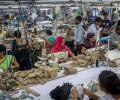
While the move may give a competitive edge over rivals like Bangladesh in the global market, several industry bodies raised concerns that many state governments may not implement it on the ground.

Fitch Ratings has said fundamentals of the Indian textiles industry are changing and the sector seems to be on a comeback trail aided by government policies and buoyant exports in 2002-03.
Acknowledging that the rupee appreciation has created some problems for exporters, the government on Tuesday assured the textile industry of addressing all its legitimate concerns to generate more employment. "I am aware that the strengthening of the rupee has created some strains for our exporters," Prime Minister Manmohan Singh said at the golden jubilee celebrations of the Confederation of Indian Textile Industry.
Some 55m jobs in India depend on the industry
Having already witnessed a job cut of around seven lakhs so far in the year, the textile industry may see a further reduction in manpower by five lakhs, given in a decline in business by 1.5 per cent.

The Indian banking sector is projected to experience a steady 9-13 per cent industrial credit growth in the first half of 2026, driven by capital expenditure, infrastructure development, and sectoral demand recovery, according to a Ficci-IBA survey.

'Workers are being pushed into 12- to 14-hour shifts under poor conditions. These largely leaderless protests are likely to continue.'

'In my experience of politics, I have seen political grips and political chokes are mostly hidden. The average person cannot see them,' Rahul Gandhi said.

Textiles, pharmaceuticals, chemicals, engineering goods, gems and jewellery exports will receive a boost from the free trade agreement between India and the 27-nation European Union, according to exporters.

India and New Zealand have signed a comprehensive Free Trade Agreement (FTA) aimed at significantly boosting bilateral commerce and investments, providing duty-free access for 100 per cent of India's exports to New Zealand and securing duty-free inputs for India's manufacturing sector.

Prime Minister Narendra Modi urged industry and start-ups to focus on quality and make excellence a benchmark in manufacturing. He also lauded the start-up ecosystem and greeted the nation on National Voters Day and Republic Day.

Rising living expenses, fear of contract hiring cast shadow on real gains.

The European Union (EU) has suspended export benefits to sectors such as textiles and plastics under a preferential scheme for India and two other countries from January 1, a move that will impact the country's shipment to the 27-nation bloc. The development is important as the two sides are likely to announce the closure of negotiations for a free tarde agreement (FTA) on January 27.
Import duty cuts on labour-intensive sectors such as textiles and footwear, as well as cars, and wines, are likely to be part of the free trade agreement between India and the 27-nation bloc European Union (EU), the conclusion of which is set to be announced on January 27 here, sources said.

The Indian government has waived customs duty on critical petrochemical products until June 30 to ensure supply stability and provide relief to consumers amid disruptions caused by the crisis in West Asia.

18 Indian-flagged vessels with 485 Indian seafarers still remain in the western Persian Gulf region

India's merchandise exports experienced a slight decrease in February, while imports surged due to increased gold and silver purchases, leading to a widened trade deficit. The West Asia crisis is expected to further impact trade in the coming months.

'There is a lot of euphoria in the country after a trade agreement is signed. But it is an illusion for us. What is more important is making it real.'

Vijay Varma delivers a tour de force performance in Nagraj Popatrao Manjule's Matka King, a compelling eight-part series that chronicles the rise and fall of a gambling trailblazer in 1960s-1970s Bombay, notes Sukanya Verma.

Commerce and Industry Minister Piyush Goyal on Sunday said Indian goods will have a competitive advantage in US markets compared to products from China and other competitor countries, which face higher levies, following the reduction in reciprocal tariffs to 18 per cent.

Backed by the 'China Plus One' sentiment globally, India's textile exports is expected to grow by 81 per cent to $65 billion by 2026 from the pre-Covid level of around $36 billion in 2019, said a report by the Confederation of Indian Industry (CII) and global consulting firm Kearney. This jump is likely to generate 7.5-10 million new jobs. A large chunk of this targeted increase, or around $16 billion may come from the China Plus One sentiment due to India's relatively large strategic depth compared with Vietnam or Bangladesh, the report said.

Rahul Gandhi said that had an INDIA Bloc government negotiated the trade agreement with the US, it would have told US President Donald Trump that he should treat India as an equal.
In the face of testing global conditions, the Ministry of Textiles has stayed the course by introducing timely policy changes and innovative programmes aimed at spurring growth and development across the organised and unorganised sectors of the industry.

The quarterly manufacturing index by the industry body Federation of Indian Chambers of Commerce & Industry (Ficci) rose to an all-time high in the third quarter of financial year 2025-26 (Q3FY26), with 91 per cent of respondents reporting either higher or same production levels, against 87 per cent in the previous quarter.

Stock market benchmark indices Sensex and Nifty ended 2.5 per cent higher on Tuesday after India and the US agreed to a trade deal under which Washington will bring down the reciprocal tariff on Indian goods to 18 per cent.

Businesses are testing new markets, tapping into domestic demand, and pushing the government for relief.

The verdict marks a notable shift from a series of recent wins for Trump at the Supreme Court.

'Don't look at Russia only as a place to earn quickly and then leave.' 'Try to build experience in serious companies, skills and certifications that will serve you anywhere in the world.'
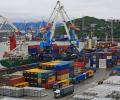
US and India will promptly implement this framework and work towards finalising the interim agreement with a view to concluding a mutually beneficial bilateral trade agreement.

The ruling is expected to have wide-ranging consequences for global trade, businesses, consumers, inflation trends and household finances across the country.
The country's exports rose marginally by 0.61 per cent to $36.56 billion in January, while trade deficit widened to a three-month high of $34.68 billion, government data showed on Monday.

Both countries commit to provide each other preferential market access in sectors of respective interest on a sustained basis

New Delhi will substantially reduce tariffs on industrial and agricultural goods while continuing to protect sensitive sectors. Tariffs on some agricultural products that are not traditionally considered sensitive will be brought down to zero, while in the case of relatively sensitive items, duties will be reduced in a graded manner and quotas will be imposed.
 © 2026 Rediff.com - Advertise with us - Disclaimer - Privacy Policy - Sitemap - Feedback - About us - Terms of use - Grievances